Case study
Study Abroad Student
Connection Project Plan
A full project management plan, charter, scope statement, work breakdown structure, schedule, RACI matrix, budget, and risk register, for a proposed internal Quinnipiac University website connecting prospective study abroad students with past participants. Built for MG 603 and delivered as a 10-minute plan pitch to course leadership.
01 · Overview
The problem
Prospective Quinnipiac students considering a semester abroad rely mostly on informational resources, program brochures, general advising pages, and static descriptions, with no easy way to hear directly from students who have actually done the program. That gap makes it harder to evaluate whether a specific program fits, and it pushes more of that context-gathering work onto the Study Abroad Office's advising staff.
The proposed solution
An internal-facing website that pairs prospective students with past study abroad participants, built around standardized student profiles covering program location, duration, scholarship and work options, experience narratives, photos, and academic and cultural considerations, alongside advising content to help students plan electives around a semester or short-duration program abroad.
What this project actually delivered
This was a planning engagement, not a build. The deliverable is the project management plan itself, the charter, scope statement, WBS, schedule, RACI, budget, and risk register needed to take the website from idea to a fundable, executable initiative. No design, coding, deployment, or collection of real student data happened as part of this plan. Those are explicitly scoped as future implementation work.
02 · Charter & scope
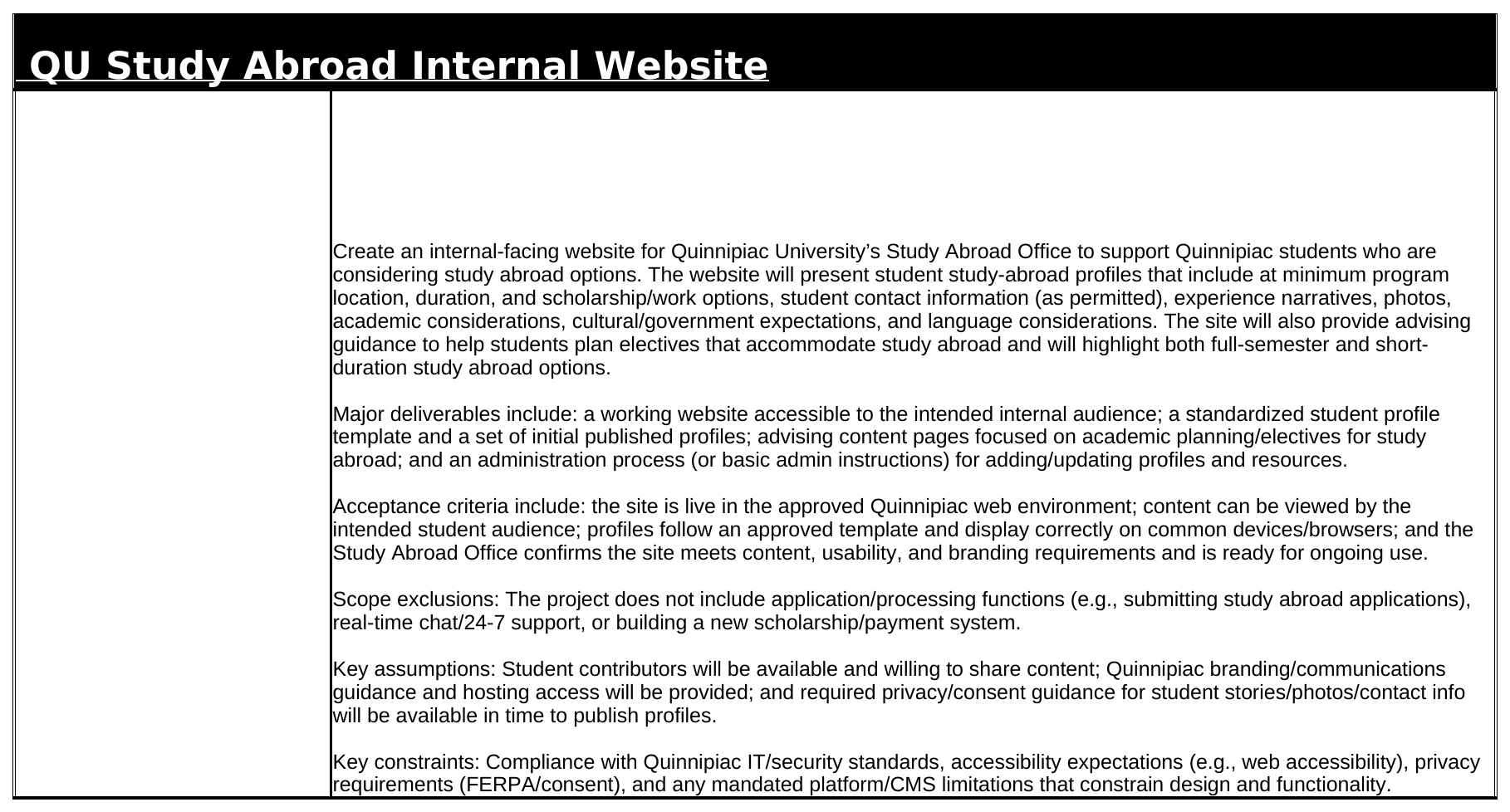
The charter set the justification. There is currently no centralized platform that organizes study abroad returnee experiences and advising resources in one place. Major deliverables were defined as a working website accessible to the intended internal audience, a standardized student profile template with an initial set of published profiles, advising content focused on academic planning and elective sequencing, and a basic administration process for adding and updating profiles going forward.
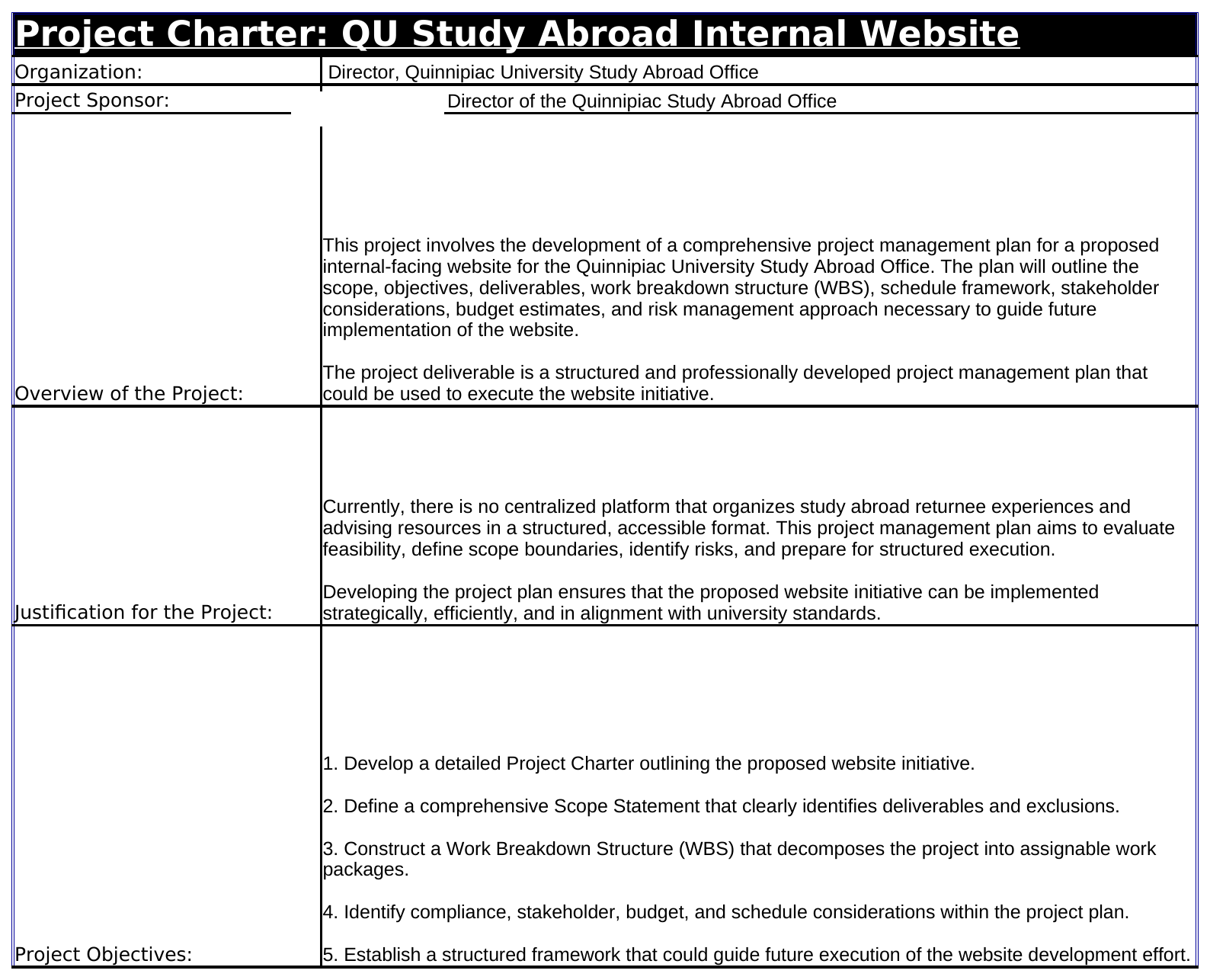
Scope exclusions were set deliberately narrow for this phase, with no application or processing functionality (students still apply through existing channels), no real-time chat or 24/7 support, and no new scholarship or payment system. Key constraints carried through the whole plan, including compliance with Quinnipiac IT and security standards, web accessibility expectations, and FERPA and consent requirements for publishing any student story, photo, or contact information.
03 · Work breakdown structure
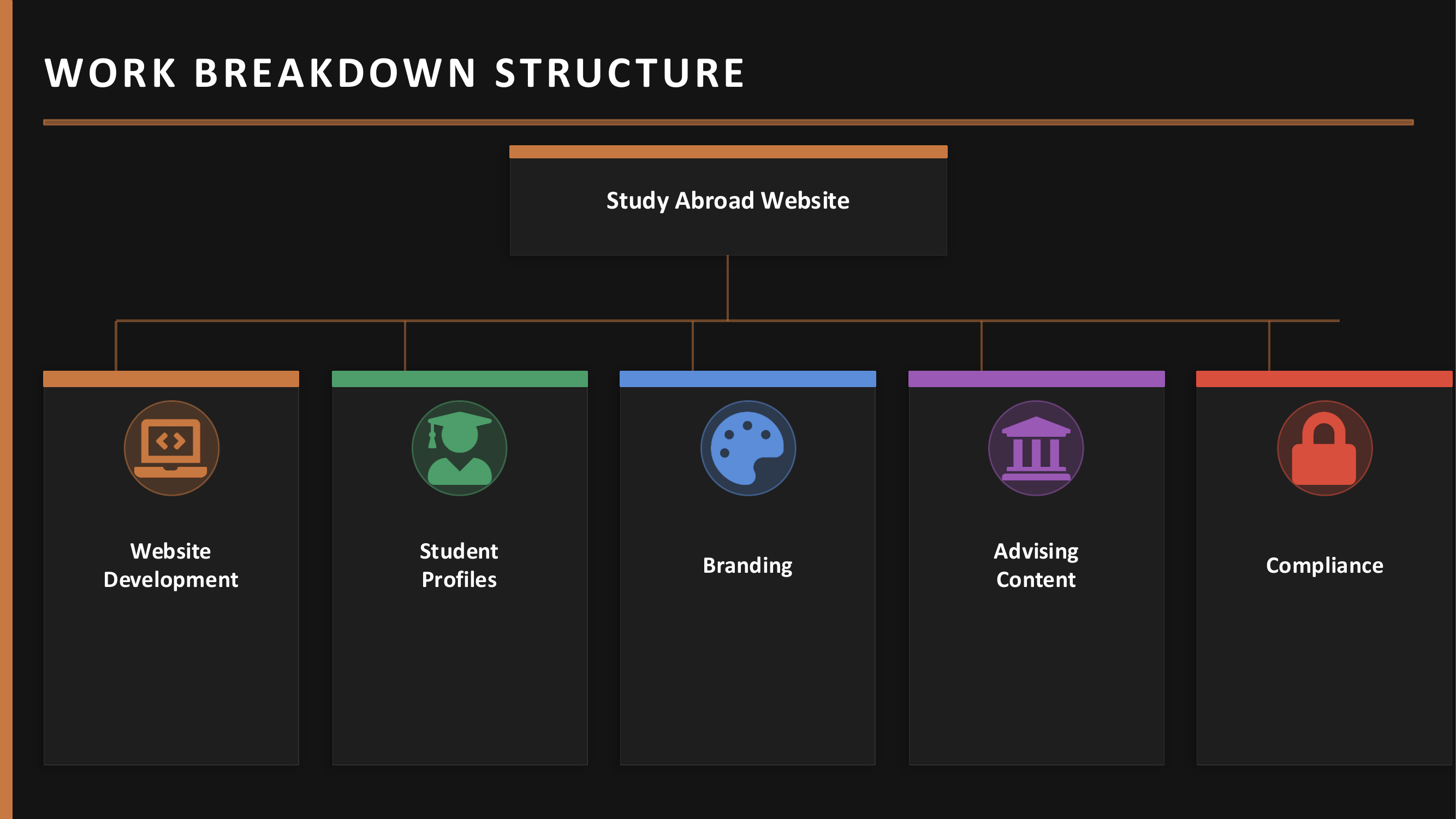
The WBS decomposes the initiative into five work packages, Website Development, Student Profiles, Marketing & Branding, Advising & Budget Information, and IT & Security, each broken down to a third level of assignable tasks (for example, Website Development splits into Design, Build, Testing, Launch, and Maintenance & Training, with each of those further decomposed into specific working tasks, numbered down to the 1.1.1 level).
04 · Schedule & dependencies
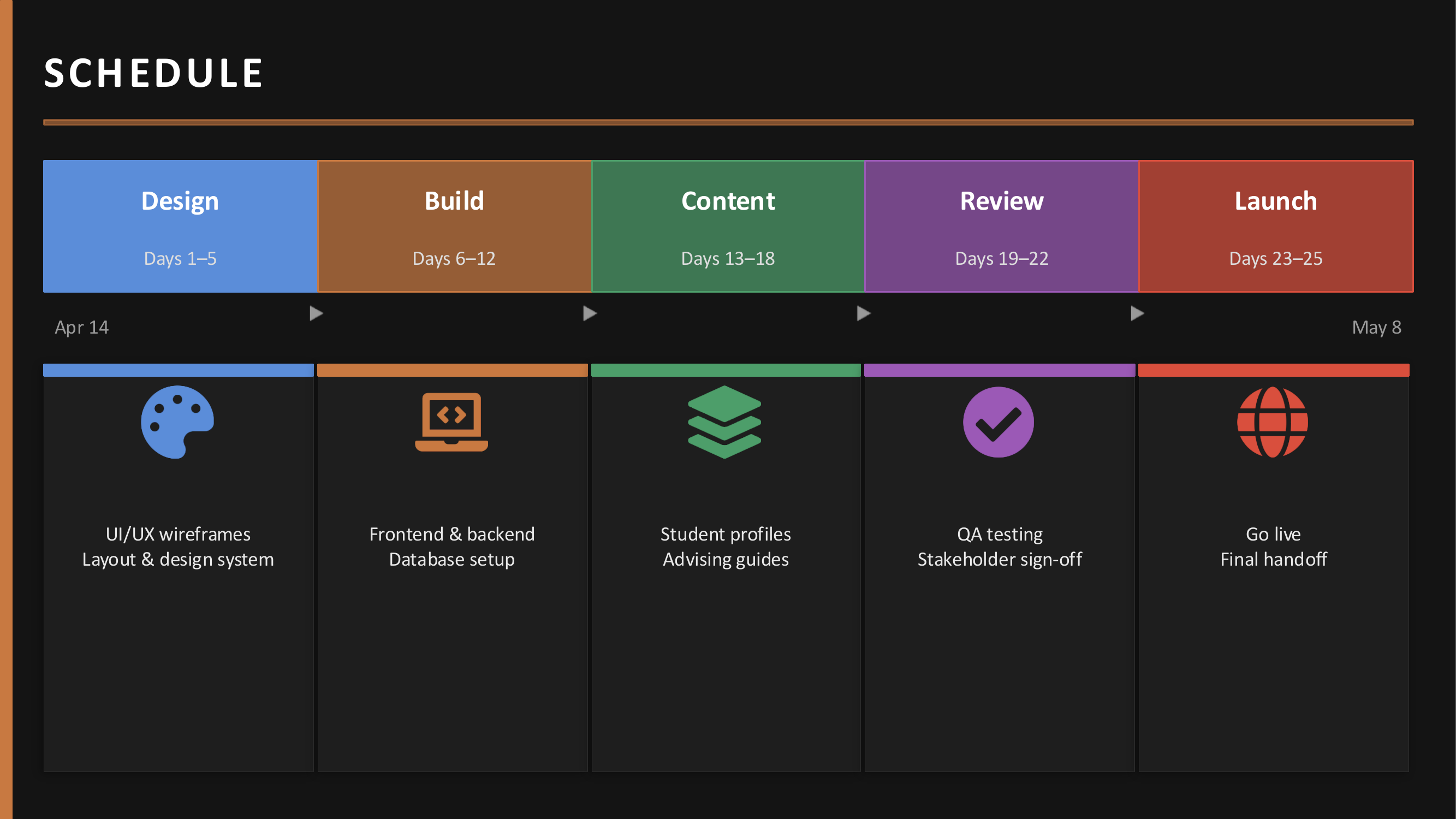
The plan is sequenced across a 25-day window (April 14 to May 8) at the individual task level, with a start date, end date, and predecessor mapped for every WBS item. UI has to be finalized before development starts, student consent has to be collected before profile content is built, and FERPA compliance review is a hard prerequisite for launch.
05 · RACI & stakeholder roles
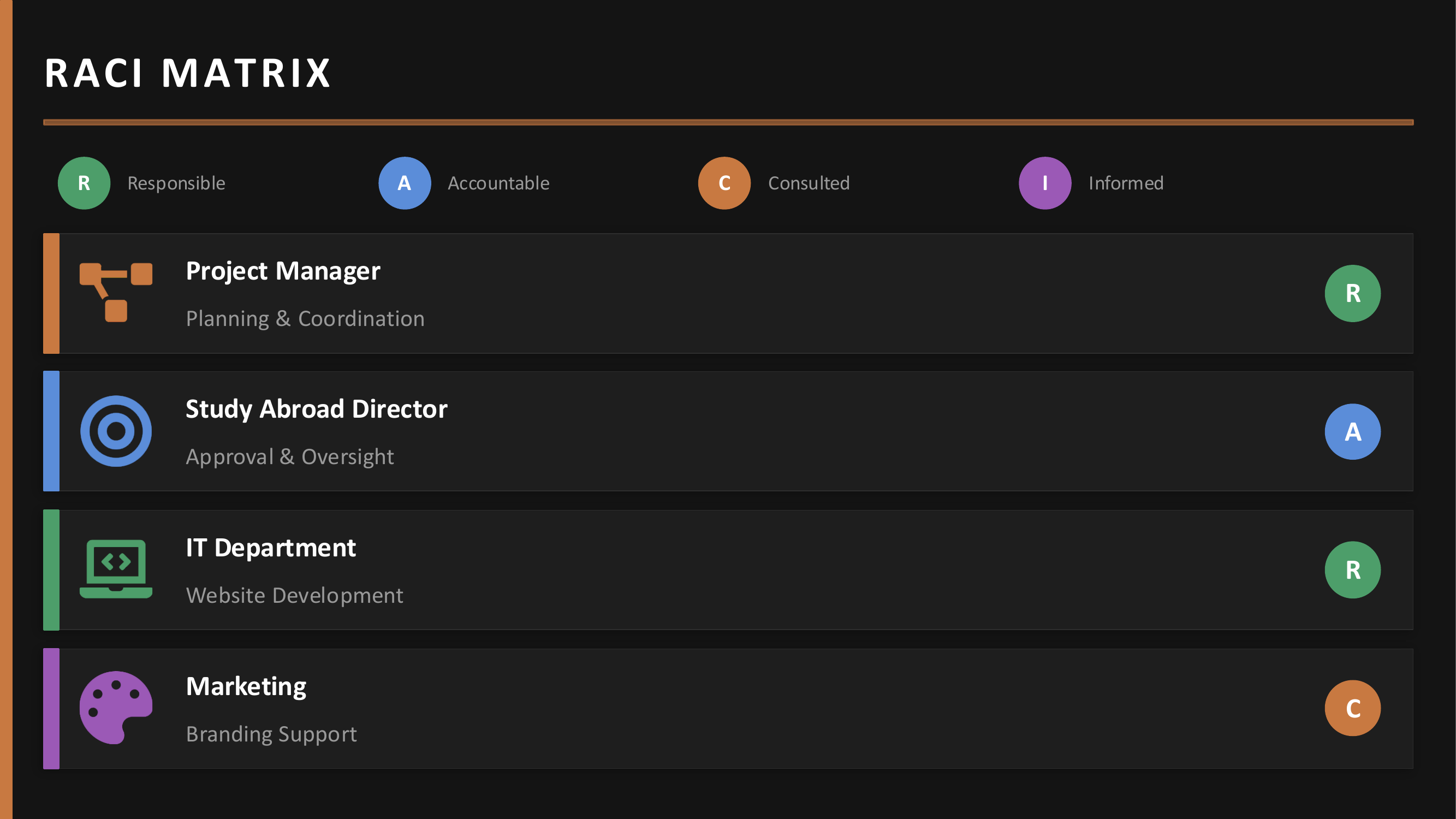
Five stakeholder groups touch the project, the Project Manager, the Study Abroad Office, the IT Department, Marketing, and the students themselves (as both content contributors and end users). The RACI matrix assigns a role on every task rather than just the work package level, IT is Responsible for build and deployment tasks, the Study Abroad Office is Responsible for advising content and student outreach, Marketing is Responsible for branding tasks and Consulted elsewhere, and the Project Manager is Accountable throughout.
06 · Budget & risk management
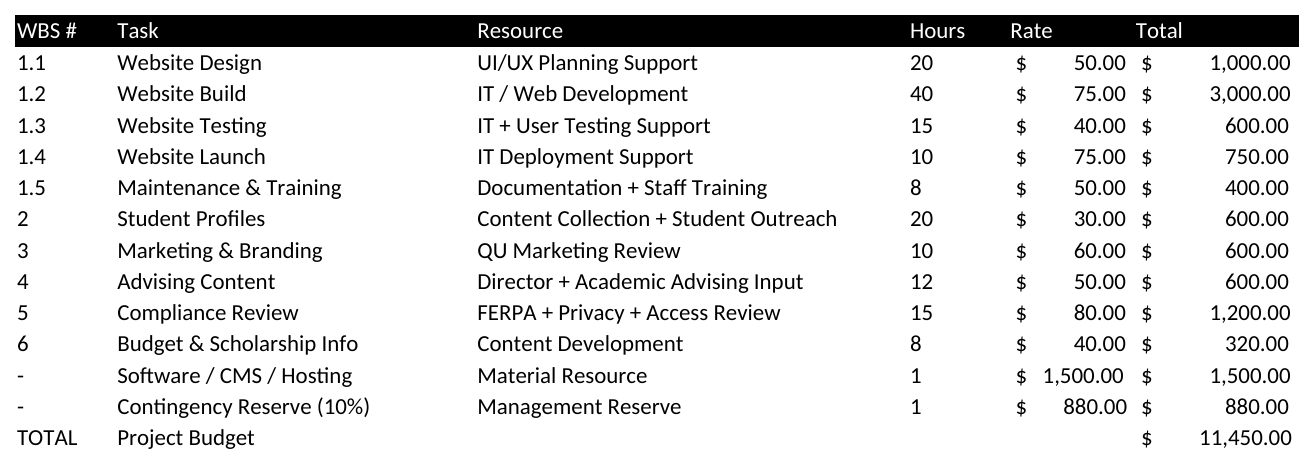
The rough-order-of-magnitude budget estimate totals $11,450, built bottom-up from hours and a blended rate against each WBS work package. That includes website design, build, testing, launch, and maintenance, student profile content collection, marketing review, advising content, FERPA and privacy compliance review, and software, CMS, and hosting costs, plus a 10% management reserve.
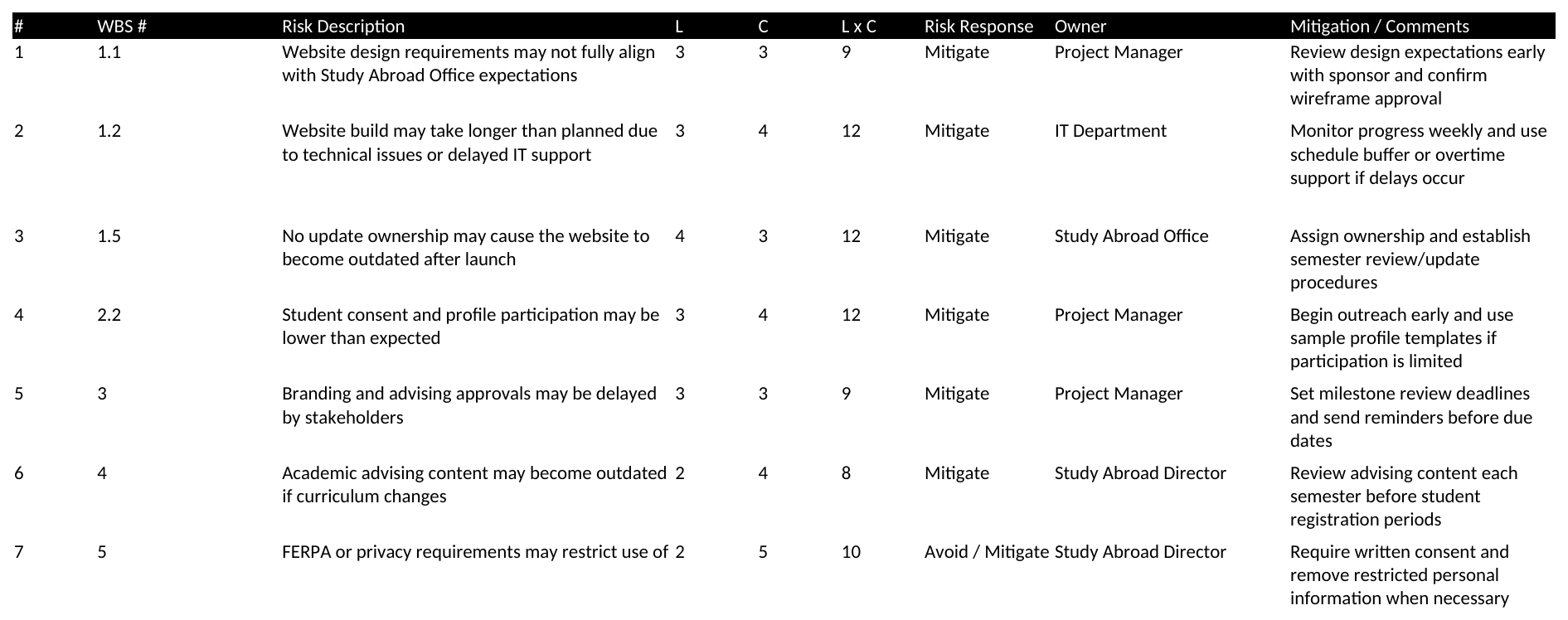
The risk register carries seven identified risks, each scored on a likelihood and consequence scale, and each paired with a named owner and a specific mitigation response rather than left as an open concern. The highest-scored risks are website build delays from technical issues or limited IT support, no clear ownership for keeping the site updated after launch, and lower than expected student consent and profile participation.
07 · Recommendation
The plan's own recommendation was to proceed with phased implementation once resources become available, rather than a full build-out in one pass. The deliverable for this engagement was the plan itself, a charter, scope statement, WBS, schedule, RACI, budget, and risk register complete enough to hand to the Study Abroad Office and IT as a starting point for an actual build, without committing to implementation before it's funded and staffed.