Case study
Hamden Fire Department
& IABPFF Consulting Project
A consulting engagement with the Hamden Fire Department and the International Association of Black Professional Firefighters, researching firefighter health and safety, workforce diversity, and recruitment, then translating that research into a digital-first strategy for reaching younger recruits.
01 · Overview
The engagement
As part of a graduate-level consulting lab, our five-person team was engaged by the Hamden Fire Department and the International Association of Black Professional Firefighters (IABPFF) to research organizational challenges and develop practical recommendations. The IABPFF is a national advocacy organization focused on racial equity, mentorship, and community safety within the fire service, and Hamden's chapter partnered with the department directly on this project.
The goal
The team was asked to research and deliver recommendations across four areas, firefighter health and safety, the underrepresentation of women in the fire service, recruitment and outreach to younger generations, and community-facing social media campaigns. The engagement concluded with a written consulting report and a formal stakeholder presentation.
02 · Team research
Before narrowing into recruitment, the team researched the conditions shaping the profession itself. Firefighting carries risks that extend well beyond the emergency scene. Published research shows cancer accounted for 66% of career firefighter line-of-duty deaths between 2002 and 2019, driven by cumulative exposure to carcinogens like benzene and formaldehyde and by "off-gassing" from contaminated gear. Mental health outcomes were similarly stark. Firefighter suicide rates run well above the general population, and PTSD affects roughly 20% of the workforce, nearly three times the civilian rate, a gap the team traced to a culture that discourages talking about psychological strain.
The team also researched why women remain underrepresented in fire services nationally (roughly 9% of the workforce). Contributing factors included physiological bias in physical testing standards, poorly fitting protective equipment designed around male sizing, and reproductive health risks that only recently began receiving the same presumptive coverage given to men. The team's recommendations centered on reducing certification barriers to entry, investing in properly fitted equipment, and normalizing mental health support alongside physical safety protocols.
03 · Reaching Gen Z
My specific focus on the team was researching how Hamden Fire Department could better connect with Gen Z and younger prospective recruits. I looked at how younger audiences discover and evaluate career opportunities, and how that behavior differs from previous generations, since the department's existing recruitment approach relied heavily on more traditional channels.
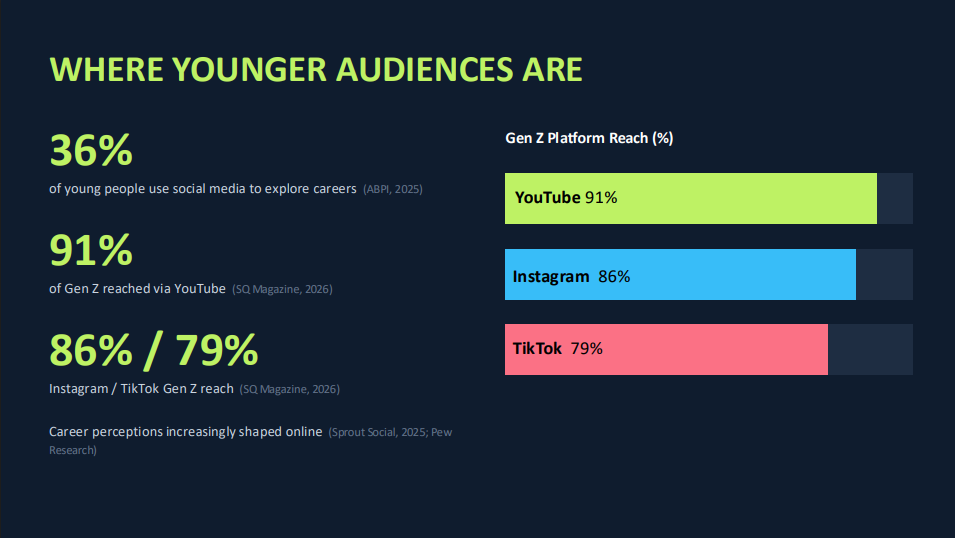
Published research shows Gen Z spends a disproportionate share of its time on a small set of video-first platforms, reaching 91% of Gen Z on YouTube, 86% on Instagram, and 79% on TikTok, and that this behavior directly shapes how they discover and evaluate career paths.
04 · Recommendation
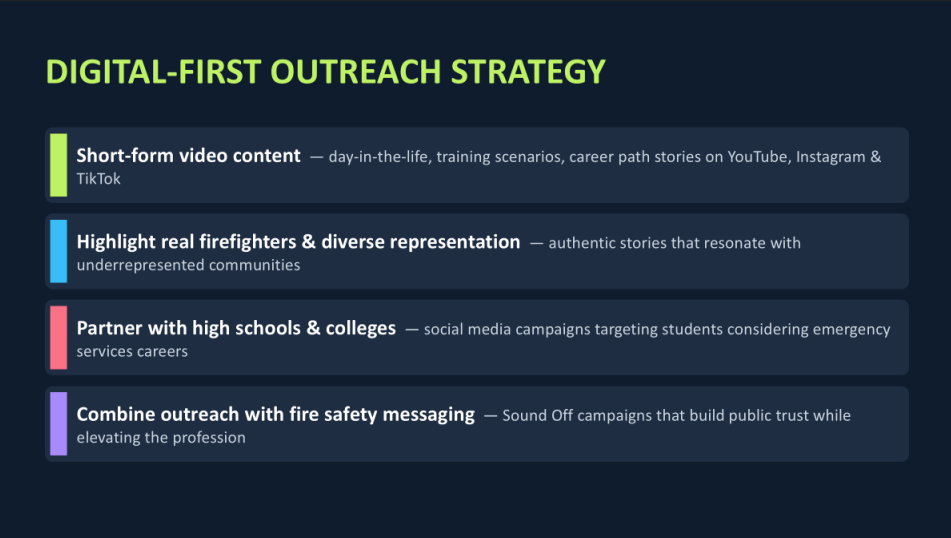
Based on this research, I developed a recommendation for a digital-first recruitment strategy built around short-form video, day-in-the-life content, training footage, and career-path stories published on YouTube, Instagram, and TikTok, with diverse representation featured throughout. Research also indicated that seeing someone with a similar background in a role meaningfully influences how young people evaluate whether a career is accessible to them, which directly supported the IABPFF's own representation goals.
I paired the digital recommendation with in-person outreach, connecting the online content to career fairs, station visits, and partnerships with local high schools and colleges. The strategy was designed to serve two goals at once, building a stronger recruitment pipeline, and extending the reach of the department's Community Risk Reduction work, including fire prevention education and the Sound Off smoke alarm awareness program, since younger audiences also act as messengers of safety information within their own households.
05 · Outcome
The team's research and recommendations were delivered as a final written consulting report and a formal presentation to Hamden Fire Department and IABPFF stakeholders. The engagement demonstrated how public research on workforce health, diversity, and generational behavior can be turned into a concrete, low-cost recruitment strategy for a public-sector client, applying the same research-to-recommendation process used in client-facing analytics and marketing work.